




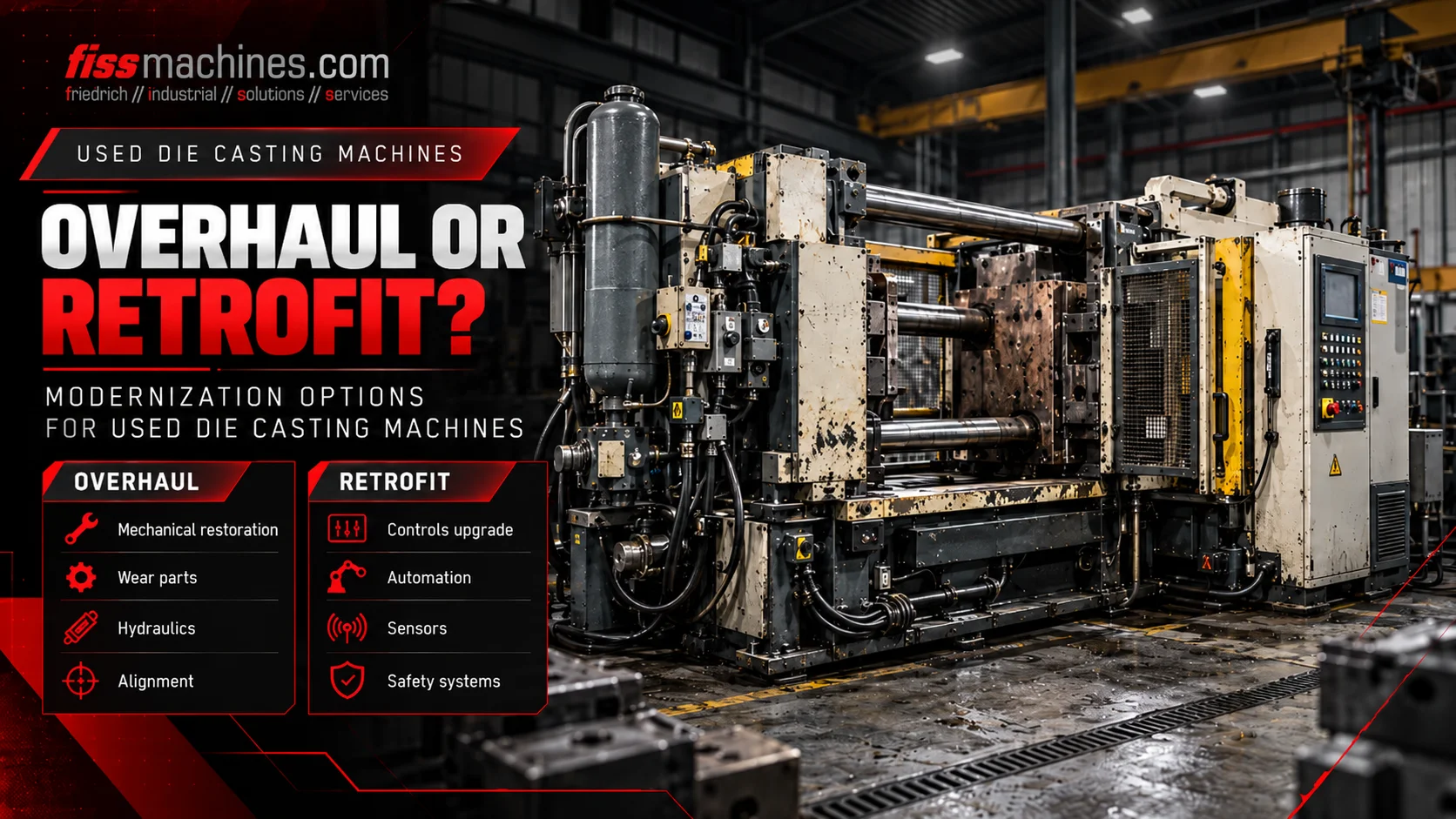
Overhaul or Retrofit? Modernising Used Foundry Machines
A used die casting machine or furnace often has a robust structure that can run for many more years. What limits it is usually something else: worn hydraulics, an obsolete control for which spare parts are hard to find, or a safety concept that no longer matches current expectations. "Overhaul" and "retrofit" are often used as if they meant the same thing. They do not, and confusing them leads to wrong budgets and wrong expectations.
What Is the Difference Between Overhaul and Retrofit?
An overhaul restores the machine's mechanical, hydraulic and electrical condition, largely within its original design: seals, cylinders, pumps, valves, guides and wear parts are inspected, repaired or replaced. A retrofit changes the design, typically by replacing the control, drives, sensors or shot control with current technology.
Both have to be followed by a safety review. Whether a modified machine meets the requirements at its place of use is not automatic; it depends on the scope of the changes and has to be assessed and documented.
What an Overhaul Covers
An overhaul starts with a structured inspection and ends with a function test. In between, the scope can range from replacing a few seals to dismantling the machine completely. Terms such as "partial overhaul" and "full overhaul" are not standardised, so the actual list of work matters more than the label.
Typical scope on a die casting machine
- Hydraulic cylinders resealed, rods and bores checked
- Pumps, valves and filters inspected or replaced, oil changed
- Accumulators inspected according to applicable rules
- Platen parallelism, tie bars and guides measured
- Toggle bushings and pins checked on toggle machines
- Shot cylinder, shot sleeve mounting and coupling inspected
- Cooling, lubrication and electrical wiring checked
An overhaul is the right approach when the structure is sound and the existing control still works reliably and can be supported with spare parts. It preserves the machine's known behaviour and documentation.
When a Retrofit Makes Sense
Controls age faster than steel. A machine may be mechanically fit, but its control can no longer be repaired economically, or it cannot provide the data and interfaces a modern cell expects. A retrofit then replaces selected systems with current components.
New PLC and operator panel with current software and documentation.
Valves, sensors and recording for a more repeatable shot and usable shot curves.
Pump drives or motor control updated where the hydraulic design allows it.
Signals for robots, sprayers, presses and data collection.
Retrofits are projects, not repairs. They need a specification, software engineering, commissioning and new documentation, and they change how operators and maintenance staff work with the machine. How peripheral units connect in a cell is described in our article on automation in the die casting cell.
Safety Revalidation: Not Automatic
Every overhaul and especially every retrofit touches safety-related functions: guards, interlocks, emergency stop, two-hand controls, and the behaviour of hydraulics when energy is removed. After the work, these functions have to be checked and the result documented.
Beyond testing, the scope of a modification can have legal consequences. In the European Union, a modification that was not foreseen by the original manufacturer and that affects safety, by creating a new hazard or increasing an existing risk, may be considered substantial. Whoever carries it out can then take on manufacturer obligations, including risk assessment and conformity documentation. The EU Machinery Regulation (EU) 2023/1230, which applies from January 2027, explicitly addresses such substantial modifications. Whether a specific project is affected has to be assessed case by case; operator obligations under national workplace safety rules apply in any case.
Neither an overhaul nor a retrofit makes a machine compliant by itself. Plan the safety review as part of the project from the start, with qualified people and clear responsibilities between supplier and operator.
Overhaul, Retrofit and Safety Review Compared
| Aspect | Revizie mecanică | Retrofit control | Revizuire de siguranță |
|---|---|---|---|
| Scop | Restabilirea condiției și fiabilității | Înlocuirea sistemelor învechite, adăugarea de funcții | Confirmarea funcționării în siguranță și documentarea acesteia |
| Schimbare de design | În mare parte niciun | Da, în sistemele modificate | Posibil, dacă sunt necesare măsuri |
| Principalele riscuri | Daune ascunse descoperite în timpul demontării | Extinderea scopului, software, timpul de punere în funcțiune | Descoperire târzie a măsurilor lipsă |
| Documentație | Inspecție și rapoarte de lucru | Diagrama de circuite noi, software, manuel | Evaluare de risc, înregistrări de test |
| Declanșator tipic | Uzură, scurgeri, proces instabil | Lipsă de piese de schimb, nevoi de date | Orice modificare, relocare, nou amplasament |
Cum să Decideți: Cinci Întrebări
este structura solidă?
Fisuri în plăci sau cadru, ghidajele purtate semnificativ sau cordoanele de legătură avariate pot face orice investiție ulterioară problematică.
Poate fi în continuare sprijinit controlul?
Verifica disponibilitatea pieselor de schimb, backup-urile software și oamenii care pot să-l întrețină.
Cce cere procesul?
Piesele cu cerințe ridicate de calitate pot necesita un control mai bun al armei sau înregistrarea datelor decât oferă mașina originală.
Ce necesită revizuirea de siguranță?
Clarificați devreme care măsuri sunt necesare la locul utilizării și cine este responsabil pentru ele.
Cum se compară costul și timpul de nefuncționare?
Comparați proiectul întreg, inclusiv punerea în funcțiune și instruirea, cu alternative precum o mașină uzată diferită.
Inspectarea unei mașini înainte de achiziție este un pas separat. Întrebările de mai sus se referă la ceea ce se întâmplă odată ce o mașină este pe teren sau deja în producție, și la ce lucru efectiv are nevoie.
Întrebări frecvente
O mașină supusă reviziei funcționează ca una nouă?
Nu neapărat. O revizie readuce starea definită în domeniul său. Limitele de design, funcțiile de control și caracteristicile mașinii originale rămân neschimbate, cu excepția cazului în care sunt modifyate.
Se pot combina revizia și retrofit-ul?
Da, și acest lucru este obișnuit. Combinarea lor evită demontarea de două ori, dar scopul și revizuirea de siguranță ar trebui planificate împreună.
Este un retrofit întotdeauna mai bine decât păstrarea vechiului control?
Nu. Un control funcțional, bine documentat, cu piese de schimb disponibile poate fi alegerea mai economică. Un retrofit plătește atunci când obsolența, nevoile de proces sau integrarea îl fac necesar.
Are nevoie o mașină relocată de o nouă revizuire de siguranță?
O revizuire la noul amplasament este recomandabilă în orice caz, deoarece mediul înconjurător, echipamentele conectate și regulile aplicabile pot diferi.
FISS sprijină proiectele de revizie și selecția mașinii.
Discutați cu FISS despre starea mașinii dvs. și amploarea pe care o aveți în vedere, sau despre mașini uzate care ar putea fi revizuite pentru a se potrivi cerințelor dvs.
